
Introducing essential food vocabulary is crucial for beginner French learners (A1). Printable PDFs, games, and conversation starters help students
master basic terms related to nutrition and everyday eating habits.
Context of the A1 Level
At the A1 level, learners are building foundational French skills. Introducing “les aliments” (foods) provides practical vocabulary for daily life. Resources like printable FLE A1 PDFs focus on simple comprehension and expression. These materials typically present core food groups – fruits, vegetables, meats – with basic descriptions. The goal is to enable students to understand and participate in simple conversations about food preferences, laying a solid base for future language development.
Importance of Food Vocabulary in Early French Learning
Food vocabulary is exceptionally relevant for A1 learners, offering immediate practical application. Printable FLE A1 PDFs often center around nutrition, making learning engaging. Mastering terms for common foods allows students to discuss personal preferences and navigate real-life scenarios like grocery shopping or ordering at restaurants. This builds confidence and reinforces grammatical structures, fostering a positive learning experience from the outset;

Core Food Vocabulary: Building Blocks
Essential food groups – fruits, vegetables, meat, and dairy – form the foundation. FLE A1 PDFs prioritize these terms for practical communication and comprehension.
Fruits and Vegetables (Fruits et Légumes)
Mastering basic fruit and vegetable names is a cornerstone of early French learning. FLE A1 resources, often available as downloadable PDFs, frequently begin with la pomme (apple), la banane (banana), la carotte (carrot), and la tomate (tomato).
These PDFs typically include visual aids and simple exercises to reinforce vocabulary. Learners practice identifying these foods and using them in basic sentences, building a solid foundation for more complex language skills.
Meat and Fish (Viande et Poisson)
Expanding beyond produce, A1 French learners encounter common meats and fish. FLE resources, including printable PDFs, introduce words like le poulet (chicken), le boeuf (beef), le poisson (fish), and l’agneau (lamb).
These materials often feature simple dialogues or exercises where students identify these foods or express basic preferences. Mastering these terms is essential for understanding menus and discussing meals.
Dairy Products (Produits Laitiers)
Introducing dairy is vital for A1 learners. FLE PDFs commonly present le lait (milk), le fromage (cheese), and le yaourt (yogurt). These resources often incorporate visual aids and simple sentence structures to aid comprehension.
Exercises might involve matching pictures to words or completing phrases like “J’aime le…”. Understanding these basic terms builds a foundation for discussing breakfast or snacks.

Essential Phrases for Describing Food
Key phrases like “J’aime…” and “Je n’aime pas…” are foundational. FLE A1 PDFs emphasize asking “Qu’est-ce que c’est?” to identify foods easily.
“J’aime…” (I like…) and “Je n’aime pas…” (I don’t like…)
Mastering these fundamental phrases is vital for A1 learners. FLE resources, often available as PDFs, heavily emphasize their practical application when discussing food preferences. Students begin by expressing simple likes and dislikes – “J’aime le chocolat” or “Je n’aime pas le poisson.”
These structures provide a comfortable entry point for building confidence in spoken and written French, forming the basis for more complex sentences later on.
Asking “Qu’est-ce que c’est?” (What is it?)
Essential for beginners, “Qu’est-ce que c’est?” unlocks comprehension of unfamiliar foods. Many FLE A1 PDFs incorporate this question into interactive exercises, pairing it with visual aids. Learners practice identifying items and responding appropriately. This builds vocabulary and encourages active participation. It’s a cornerstone of early French communication, fostering confidence in real-life scenarios.
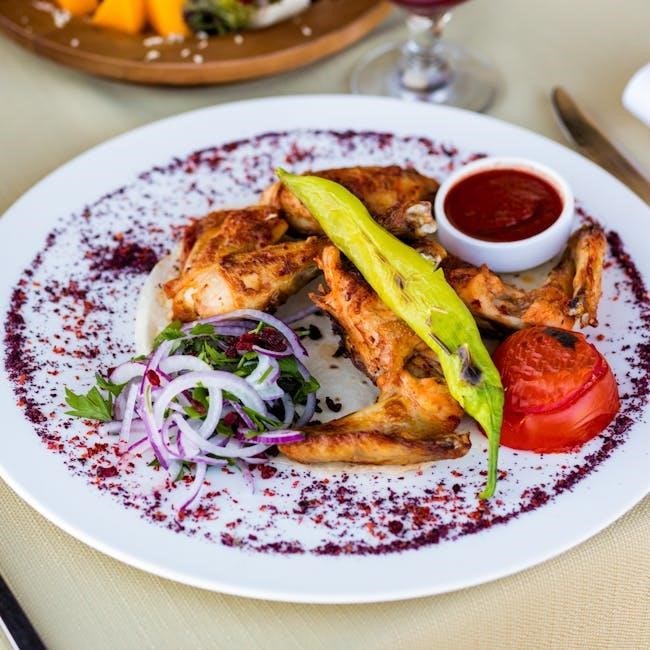
Understanding Basic Food Preferences
FLE A1 resources often focus on expressing likes and dislikes with food, utilizing simple phrases and vocabulary found in printable PDFs.
Expressing Likes and Dislikes with Specific Foods
For A1 learners, mastering “J’aime…” and “Je n’aime pas…” is fundamental. Printable FLE PDFs frequently include exercises where students pair these phrases with specific food items – le chocolat, les fruits, or le poisson.
These activities build confidence in constructing simple sentences. Focusing on common foods allows for immediate practical application, enhancing comprehension and conversational skills. PDF worksheets often provide visual aids alongside vocabulary.
Simple Questions about Food Choices
FLE A1 PDFs often introduce questions like “Qu’est-ce que c’est?” (What is it?) and “Tu aimes…?” (Do you like…?). These questions, paired with food vocabulary, encourage basic interaction.
Worksheets frequently present scenarios – a market or restaurant – prompting students to ask and answer these questions; This builds confidence in forming simple inquiries and responding appropriately, solidifying comprehension and practical language use.
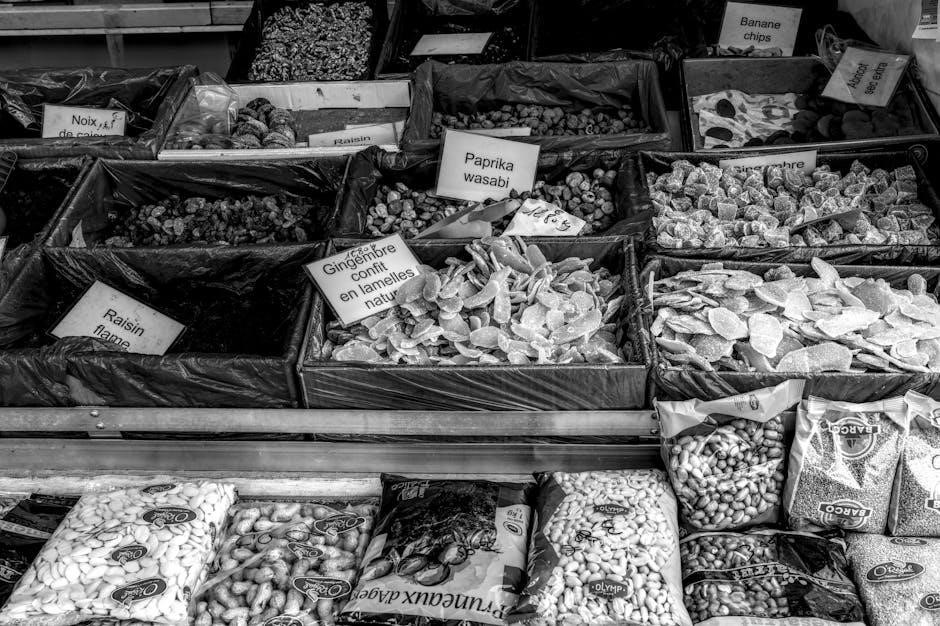
Activities for Practicing Food Vocabulary (Based on FLE Resources)
FLE resources, including PDFs, offer word searches, matching games, and printable worksheets to reinforce food vocabulary through engaging, interactive practice.
Printable Worksheets: Comprehension and Expression
Numerous free, downloadable PDF worksheets cater to A1 learners, focusing on “les aliments.” These resources typically include simple reading passages listing healthy foods, followed by comprehension questions. Activities encourage students to identify fruits, vegetables, and other food items.
Worksheets also promote expression through gap-fill exercises, sentence building, and basic writing prompts – for example, describing favorite foods or creating simple shopping lists. These materials provide a concrete approach to nutrition vocabulary.
Games and Activities: Food Word Searches & Matching
Engaging games reinforce “les aliments” vocabulary for A1 students. PDF resources often include food-themed word searches, challenging learners to identify hidden terms in French. Matching exercises pair food names with corresponding images, aiding visual recognition and recall.
Interactive activities, like labeling food items or creating simple menus, further solidify understanding. These playful methods make learning enjoyable and boost retention, complementing traditional worksheet practice.
Conversation Starters: Discussing Favorite Foods
Facilitate simple conversations using prompts like “Qu’est-ce que tu aimes manger?” (What do you like to eat?). PDF resources provide structured dialogues focusing on food preferences. Encourage students to share their favorite fruits, vegetables, or meals in French.
Role-playing scenarios, such as ordering food, build confidence. These interactive exercises promote practical language use and help students personalize their learning experience, fostering fluency.
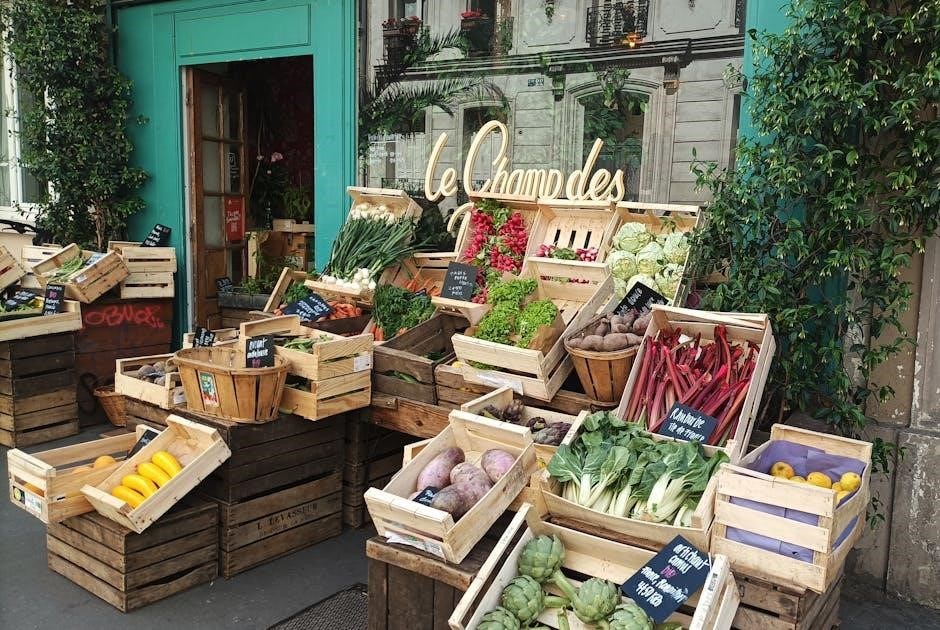
Grammar Focus: Articles and Gender Agreement
Mastering definite (le, la) and indefinite (un, une) articles is key. Food nouns offer excellent practice with masculine and feminine gender agreement for A1 learners;
Definite and Indefinite Articles with Food Items (le, la, un, une)
Understanding the correct article is fundamental. “Le” precedes masculine nouns like le chocolat, while “la” marks feminine nouns such as la pomme.
“Un” (a/an) and “une” introduce singular nouns – un biscuit, une orange.
A1 learners benefit from focused exercises identifying and applying these articles with common food vocabulary. PDF resources often include fill-in-the-blank activities to reinforce this crucial grammar point, building a solid foundation for future French studies.
Masculine and Feminine Nouns: Common Food Examples
Mastering gendered nouns is key for A1 French. Le poisson (fish) and le sucre (sugar) are masculine, while la viande (meat) and la fraise (strawberry) are feminine.
PDF worksheets frequently present food items, requiring students to identify their gender. Recognizing these patterns early simplifies sentence construction and avoids common grammatical errors, fostering confidence in basic communication.
Cultural Aspects of French Cuisine
Exploring regional specialties and meal times provides context. PDFs can showcase traditional dishes, enriching vocabulary and offering insights into French dining customs for A1 learners.
Regional Specialties and Food Traditions
France boasts diverse culinary traditions! PDFs illustrating regional dishes – like Breton crêpes or Provençal ratatouille – enhance learning. Introducing these specialties alongside basic vocabulary (fruits, vegetables, meats) contextualizes language use. Learners discover that food isn’t just sustenance, but a cultural identifier. Exploring these traditions fosters appreciation and provides authentic language practice, moving beyond simple lists of les aliments. This approach makes learning more engaging and memorable for A1 students.
Meal Times and Eating Habits in France
French meal structure differs from many cultures! PDFs detailing typical petit déjeuner (breakfast), déjeuner (lunch), and dîner (dinner) routines are valuable. A1 learners benefit from understanding that bread is a staple, and meals are often social events. Discussing these habits, alongside food vocabulary, provides cultural context. This practical knowledge enhances comprehension and prepares students for real-life interactions involving les aliments and dining in France.
Resources for FLE A1 Food Learning
Numerous online dictionaries, vocabulary lists, and downloadable PDF worksheets offer A1 learners focused practice with food terms and related exercises.
Online Dictionaries and Vocabulary Lists
For A1 students, several websites provide accessible French-English dictionaries with food-related terms. Dedicated vocabulary lists specifically curated for beginner learners are invaluable. These resources often include audio pronunciations, aiding comprehension; Websites like WordReference and specialized FLE sites offer comprehensive lists. Printable PDFs featuring common food items, categorized by type (fruits, vegetables, meats), are readily available, supporting independent study and classroom activities. These tools build a solid foundation for discussing food in French.
PDF Worksheets and Activity Packs
Numerous free PDF worksheets focus on “les aliments” for A1 learners. These resources typically include comprehension exercises based on short texts listing healthy foods, matching activities, and simple writing prompts. Activity packs often incorporate food-themed word searches and labeling exercises. Sites like Les Zexperts FLE offer comprehensive packs covering vocabulary, conversation, and games, all downloadable in PDF format, ideal for reinforcing learning and assessment.

Expanding Vocabulary: Beyond the Basics
Introduce drinks like water and juice, alongside snacks such as chocolate and biscuits, building upon core food vocabulary with readily available PDF resources.
Drinks (Boissons) — Water, Juice, Milk
Expanding beyond basic foods, introducing boissons (drinks) is vital. Key vocabulary includes l’eau (water), le jus (juice), and le lait (milk). Many FLE A1 PDF resources incorporate these terms within simple dialogues or picture-matching exercises. Learners can practice asking “Qu’est-ce que tu bois?” (What are you drinking?). Focus on pronunciation, as French nasal sounds can be challenging. Reinforce learning through visual aids and interactive activities found in downloadable worksheets.
Snacks (Les Collations) — Chocolate, Biscuits
Introducing les collations (snacks) adds practicality to A1 French. Common terms are le chocolat (chocolate) and les biscuits (biscuits/cookies). Many FLE A1 PDFs utilize these words in relatable contexts, like describing preferences: “J’aime le chocolat!” (I like chocolate!). Activities often involve identifying snacks in pictures or simple shopping scenarios. Emphasize gender agreement – le for masculine, les for plural – to build a solid grammatical foundation.
Pronunciation Tips for Food Words
Mastering French food vocabulary requires attention to pronunciation. Utilize audio resources alongside PDFs to correctly pronounce challenging sounds and words.
Common Pronunciation Challenges
For A1 French learners, pronouncing food words presents unique hurdles. Nasal vowels, often found in words like “pomme” (apple), require practice. Silent letters, common in French, can also be tricky – consider “chocolat.” The liaison, connecting the final consonant of one word to the initial vowel of the next, impacts fluency.
PDF resources often include audio, vital for correct pronunciation. Pay close attention to the ‘r’ sound, differing significantly from English. Consistent listening and repetition, using available materials, are key to overcoming these challenges and building confidence.
Using Audio Resources for Practice
Leveraging audio is paramount for mastering French food vocabulary. Many FLE A1 PDF resources now incorporate sound files, enabling learners to hear native pronunciation. Online dictionaries also provide audio clips for individual words like “pain” or “fromage.”
Repeated listening, coupled with shadowing – mimicking the speaker – significantly improves accuracy. Utilize these resources to refine pronunciation, intonation, and rhythm, building confidence in spoken French and enhancing comprehension skills.

Assessment: Testing Food Vocabulary Knowledge
Evaluate comprehension with simple quizzes, matching exercises, and role-playing scenarios—like ordering food. PDF worksheets often include these activities for A1 learners.
Simple Quizzes and Matching Exercises
Utilize readily available PDF resources offering basic quizzes to assess student understanding of food vocabulary. Matching exercises, pairing French food words with corresponding images, are also effective. These assessments focus on le, la, un, une usage and gender agreement.
Focus on identifying fruits, vegetables, meats, and dairy. Quizzes should be short, with multiple-choice or fill-in-the-blank formats, reinforcing A1 level concepts.
Role-Playing Scenarios: Ordering Food
Implement role-playing activities where students practice ordering food in a simulated French café or restaurant. PDF worksheets can provide sample dialogues and vocabulary lists. Learners can take turns being the customer and the server, utilizing phrases like “Je voudrais…” and “Qu’est-ce que c’est?”.
This reinforces practical language skills and builds confidence in real-life situations, solidifying A1 vocabulary.
Common Mistakes to Avoid
Focus on gender agreement errors with food nouns (le/la) and incorrect article usage. PDF resources should highlight these common pitfalls for A1 learners.
Gender Agreement Errors
A significant challenge for A1 learners is mastering gender agreement with French food nouns. Many students incorrectly assign le (masculine) or la (feminine) to items. For example, le pomme is incorrect; it should be la pomme.
PDF worksheets focusing on food vocabulary must explicitly address this, providing practice identifying and correcting these errors. Consistent reinforcement is key to building accurate habits from the start.
Incorrect Article Usage
Beginner French learners often struggle with definite (le, la) and indefinite (un, une) articles when discussing food. Using the wrong article – for instance, saying “un lait” instead of “le lait” – is a common mistake. FLE A1 PDF resources should offer targeted exercises to practice correct article application alongside food vocabulary, reinforcing grammatical accuracy from the outset.
Integrating Food into Real-Life Scenarios
PDF resources simulating restaurant ordering and grocery shopping provide practical application of “les aliments” vocabulary, boosting confidence and fluency for A1 learners.
Ordering at a Restaurant (Commander au restaurant)
Role-playing restaurant scenarios, often found within A1-level FLE PDFs, allows students to practice requesting food and drinks. These exercises focus on key phrases like “Je voudrais…” and identifying menu items. Printable restaurant menus with common “les aliments” vocabulary enhance comprehension. Students learn to politely ask “Qu’est-ce que c’est?” and respond to questions about preferences, building essential communicative skills for real-world interactions. Utilizing PDF worksheets with dialogues further solidifies their understanding.
Shopping for Groceries (Faire les courses)
Simulating grocery shopping provides practical application of “les aliments” vocabulary. Many A1 FLE PDFs include shopping list exercises and dialogues. Students practice asking for quantities (“un kilo de…”, “une boîte de…”), identifying products, and understanding prices. Printable shopping lists and store layouts enhance realism. This activity reinforces definite and indefinite articles, alongside masculine/feminine noun agreement, crucial for successful shopping experiences.

Future Learning: Building on A1 Food Knowledge
Expanding beyond basics, learners can explore French recipes and detailed food descriptions, utilizing advanced vocabulary found in progressively challenging FLE PDFs.
Introducing More Complex Food Descriptions
Moving beyond simple naming, A2 learners begin describing food qualities – cuit, cru, frais, épicé. FLE PDFs introduce adjectives and adverbs for nuanced expression. Students practice forming complete sentences detailing tastes, textures, and origins. Resources offer exercises focusing on comparative descriptions, like “plus sucré que…” or “moins salé que…”. This builds towards discussing recipes and restaurant experiences with greater detail, utilizing expanded vocabulary lists often found within comprehensive learning packs.
Exploring French Recipes
Transitioning to recipes provides authentic context for food vocabulary. FLE A1/A2 PDFs often include simplified recipes – crêpes, salade, sandwich – with illustrated instructions. Learners identify ingredients (les ingrédients) and action verbs (mélanger, couper, cuire). This reinforces grammar through imperative forms. Exploring regional specialties, even briefly, adds cultural insight, motivating students to connect language learning with real-world culinary traditions and practical application.
Mastering food vocabulary builds practical communication skills for A1 learners, enabling basic interactions and fostering confidence in real-life French scenarios.
Reinforcing the Importance of Practical Language Skills
Focusing on “les aliments” provides immediately useful French. Learners can discuss preferences, order food, and understand simple recipes. Printable FLE A1 PDFs, like those offering comprehension exercises and vocabulary lists, solidify learning. These resources bridge the gap between classroom study and real-world application, empowering students to navigate everyday situations with greater ease and confidence. This practical approach boosts motivation and accelerates language acquisition.
Encouraging Continued Learning and Practice
Beyond basic vocabulary, A1 learners can explore regional French cuisine through readily available PDFs. Activities like food word searches and matching games, found on sites like Les Zexperts FLE, make practice enjoyable. Encourage students to utilize online dictionaries and expand their knowledge of “boissons” and “collations”. Consistent engagement with these resources fosters fluency and a lasting appreciation for French language and culture.